
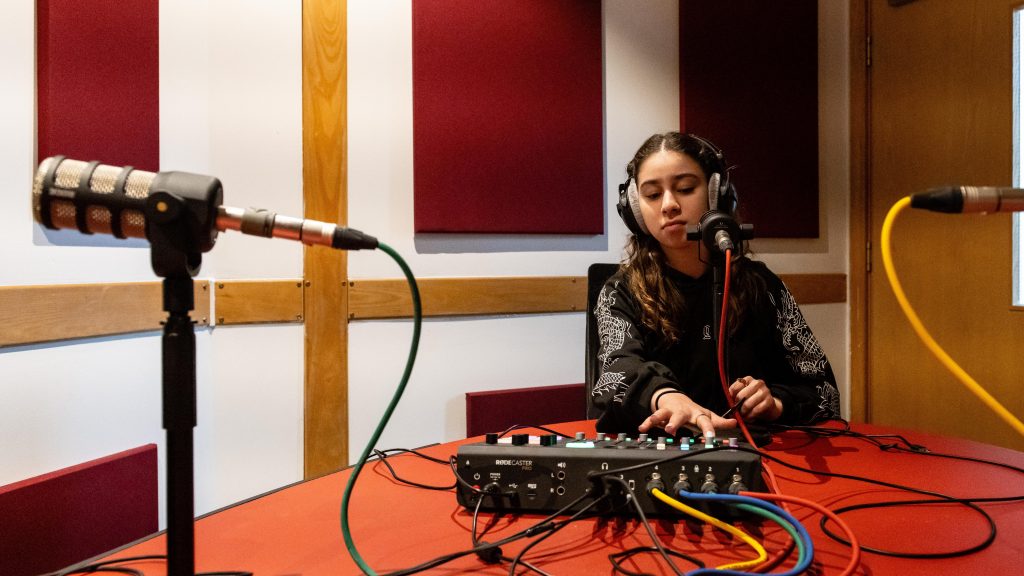
According to an Ofcom report in September 2024, almost 20% of UK adults listen to at least one podcast a week and among 15-24-year-olds the listening figures are increasing (Ofcom, 2024).
With it being a popular and growing format, then why not use it as a teaching and learning resource for your courses?
LCC Digital Learning Champion Maria Bacelar hosts a Meta Podcast about the benefits of this medium.
Benefits for Podcasts as a Teaching and Learning Resource
Maria also conducted research on the benefits and type of podcasts for teaching and learning. These include:
- Flexibility
- Accessibility
- Curriculum depth
- Student engagement
- Language exposure
- Public speaking
We recommend the podcasts are no more then 15 minutes. Podcast-based learning requires the listener to actively hold and process audio-based information, engaging in the working memory and, through the phonological loop, retaining spoken explanations.
UAL Staff Experience:
Speaking with Dr. Fotis Begklis – Film and Television Year 1 Leader – about his experience with using podcasts, he explained that they are a “powerful tool” within education. He uses an open-discussion format, often led by the students themselves, where they discuss themes related to film, representation, and inclusivity. He thinks that the process of making a podcast is equally or even more important than the final product, as it gives the podcast hosts (in this case, the students) an opportunity to “talk in a more open and deliberate way about certain subjects”. This sets the stage for “self-exploration and connection”.
Possible Podcast Formats
- Interviews with Industry professionals: Structured/ semi-structured conversations with professionals working in relevant fields. These episodes could focus on real-world experiences, career pathways, industry insights, and practical applications of theoretical knowledge.
- Student-led discussions: Encourage peer-to-peer learning through discussion of topics, course material, or even current issues. The students may share opinions, reflect on learning experiences, or debate different viewpoints (similar to the approach already implemented by Dr. Fotis Begklis). This format can influence critical thinking, public speaking skills, active engagement, and a sense of community among listeners, as students may find peer voices more relatable.
- Revision sessions: Revisiting previously-covered material and summarise important concepts in a concise way.
- Explanatory: This format is particularly useful for introducing new topics or additional concepts outside of the classroom. Content could include step-by-step explanations, real-world examples, or simplified summaries.
Call to Action
The Digital Learning Team are looking for some tutors to record one of the above types of podcasts and gather student feedback. If you think you can help support this research, or if you’d like support with the production, post production and embedding to Moodle, then please reach out – lccdigitallearning@lcc.arts.ac.uk
Resources
Using Podcasts to Enhance Learning – EdTechist
A Strategy for Using Podcasts for Teaching and Learning in the Biosciences
Teaching with Podcasts | Sheridan Center for Teaching and Learning | Brown University
Podcasts in your education, how to do it – Educational Development & Training – Utrecht University
Phonological Loop – Science Direct
What is working memory – Understood